
"I'm Fine" Is the Most Dangerous Sentence in Nigeria
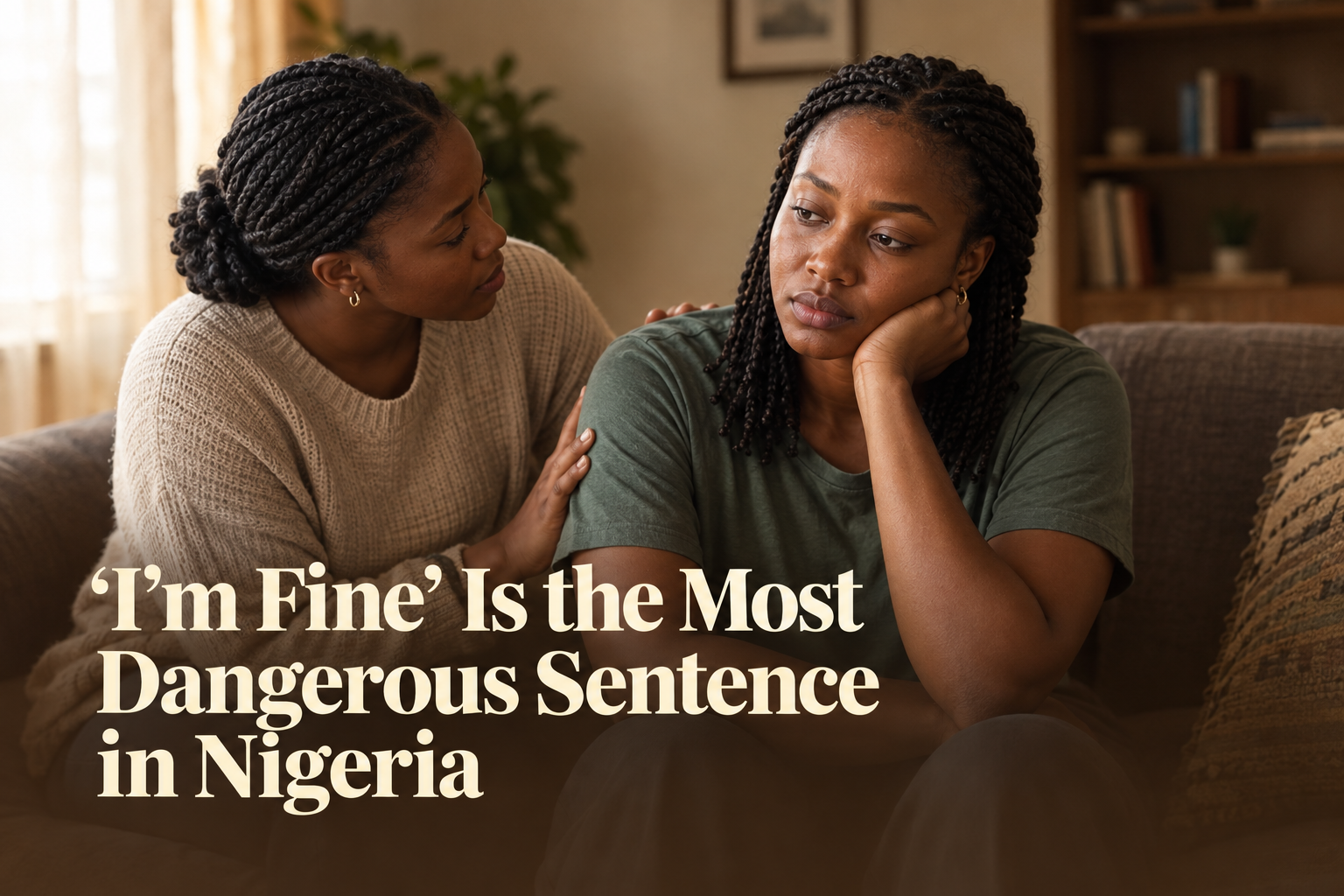
There is a sentence that every Nigerian knows how to say perfectly.
It does not matter how old you are, where you are from, or what is happening inside your chest at that exact moment. The moment someone asks how you are doing, the answer arrives before you have even thought about it.
“I'm fine.”
Two words. Automatic. Practiced. Airtight.
And in many cases, completely untrue.
We Learned This Early
Nobody sat you down and taught you to say it but you learned it anyway.
You learned it the first time you cried and were told to stop. The first time you expressed fear and were called soft. The first time you tried to explain that something was wrong and the room went quiet in a way that told you clearly, without words, that this was not a conversation this family was going to have.
So you swallowed it.
And the next time someone asked, you said “I'm fine,” and it worked. Nobody asked further. Nobody made it awkward. Life moved on. And your nervous system filed that information away carefully: silence is safer than truth.
Research on emotional suppression shows that habitually hiding or suppressing emotional experiences does not make those emotions disappear. It drives them inward where they quietly accumulate, compounding over time into anxiety, depression, physical illness, and in the most severe cases, crisis.
We were not taught to feel. We were taught to function. And for a long time, that felt like the same thing.
What "I'm Fine" Is Really Saying
If you listen carefully, really carefully, to the space around those two words, you start to hear what is actually being said.
“I'm fine” often means: I am exhausted, but I do not know how to ask for rest without feeling guilty.
“I'm fine” often means: something happened that I have not told anyone because I do not trust that they will handle it well.
“I'm fine” often means: I have been not okay for so long that I no longer remember what okay actually feels like.
“I'm fine” sometimes: I am closer to the edge than anyone around me realises, and I am terrified that if I say that out loud, I will become a burden, a prayer point, or a disappointment.
This is not a weakness. This is what happens to people who grew up in environments where emotional honesty was never modelled, never rewarded, and sometimes actively punished. Studies on emotional invalidation in childhood consistently show that when children's emotional expressions are dismissed or ignored, they develop a lifelong difficulty identifying, trusting, and communicating their own internal states.
In other words, we do not say “I'm fine” because we are dishonest.
We say it because, for many of us, honesty never felt safe enough to try.
The Culture That Made This Possible
“I'm fine” did not become Nigeria's default response by accident.
It was built carefully, over generations, by a culture that prizes strength above almost everything else. Where suffering quietly is considered a virtue. Sharing your struggles is seen as washing dirty linen in public. Where the response to pain is almost always either prayer, pepper soup, or “you will be okay”; rarely ever tell me more.
In Nigerian homes, emotions are often managed, not processed. You are told to be grateful. To remember how much worse others have it. To take it to God. To move forward. All of these things can be beautiful and also, when they become the only available response, deeply isolating.
Because what happens to the person who has prayed, who is grateful, who knows others have it worse and is still not okay?
They say “I'm fine”.
And they mean: “I have run out of places to put this.”
When "I'm Fine" Becomes Dangerous
Most of the time, “I'm fine” is a social convenience. A way of moving through the day without making things uncomfortable.
But sometimes it is something else entirely.
Sometimes it is the last thing someone says before they disappear from the group chat. Before they stop showing up. Before the people who loved them were sitting in a room asking, “But they seemed fine. We had no idea.”
Research on suicide prevention consistently identifies social isolation and the inability to communicate distress as two of the most significant risk factors in suicidal crisis. When people do not have the language, the relationships, or the cultural permission to say “I am not okay" they carry that weight alone. And some weights are too heavy to carry alone indefinitely.
This is not a dramatic edge case. This is happening in Nigerian homes, offices, universities, and churches every single day. The person who is always smiling. The one who shows up for everyone. The one you haven’t actually checked on in weeks because they always seem so fine.
What It Would Take to Change This
It starts small. Smaller than most people expect.
It starts with asking how you are and actually waiting for the answer. Not moving on when someone says “I'm fine.” Saying instead “no, really. How are you doing?” And meaning it. Creating enough safety in that moment that the real answer has somewhere to land.
It starts with unlearning the idea that needing support is weakness. That struggle is shameful. That the strongest thing a person can do is carry everything alone without complaint. Research on help-seeking behaviour shows that people are significantly more likely to reach out for support when they exist in environments where vulnerability has been modelled and normalised where they have seen someone they respect say “I was not okay, and I asked for help.”
It starts with you. The next time someone asks how you are doing and the automatic I'm fine rises to your lips pausing. Checking. Asking yourself honestly: “Is that true? And if it isn't, is there one person I trust enough to say so?”
A Word Before You Go
If you have been saying I'm fine for so long that you are not sure what the truth even is anymore that is not a small thing. That is a sign that something in you has been waiting a very long time to be heard.
You do not have to be in crisis to deserve support. You do not have to have completely fallen apart before your pain counts. You are allowed to reach out before the weight becomes unbearable and you are allowed to find a space where “I'm fine” is never the answer you have to give.
At NDIDI, we offer exactly that space. A place where the real answer is not just welcomed , it is the whole point. If you are ready to stop saying I'm fine and start saying what is actually true, we are here.
If cost has been a barrier, we offer an affordable therapy package with our therapist, Oluwagbemisola Osoba, because access to honest support should never be a luxury.