
You Are Not Depressed Because You Are Ungrateful
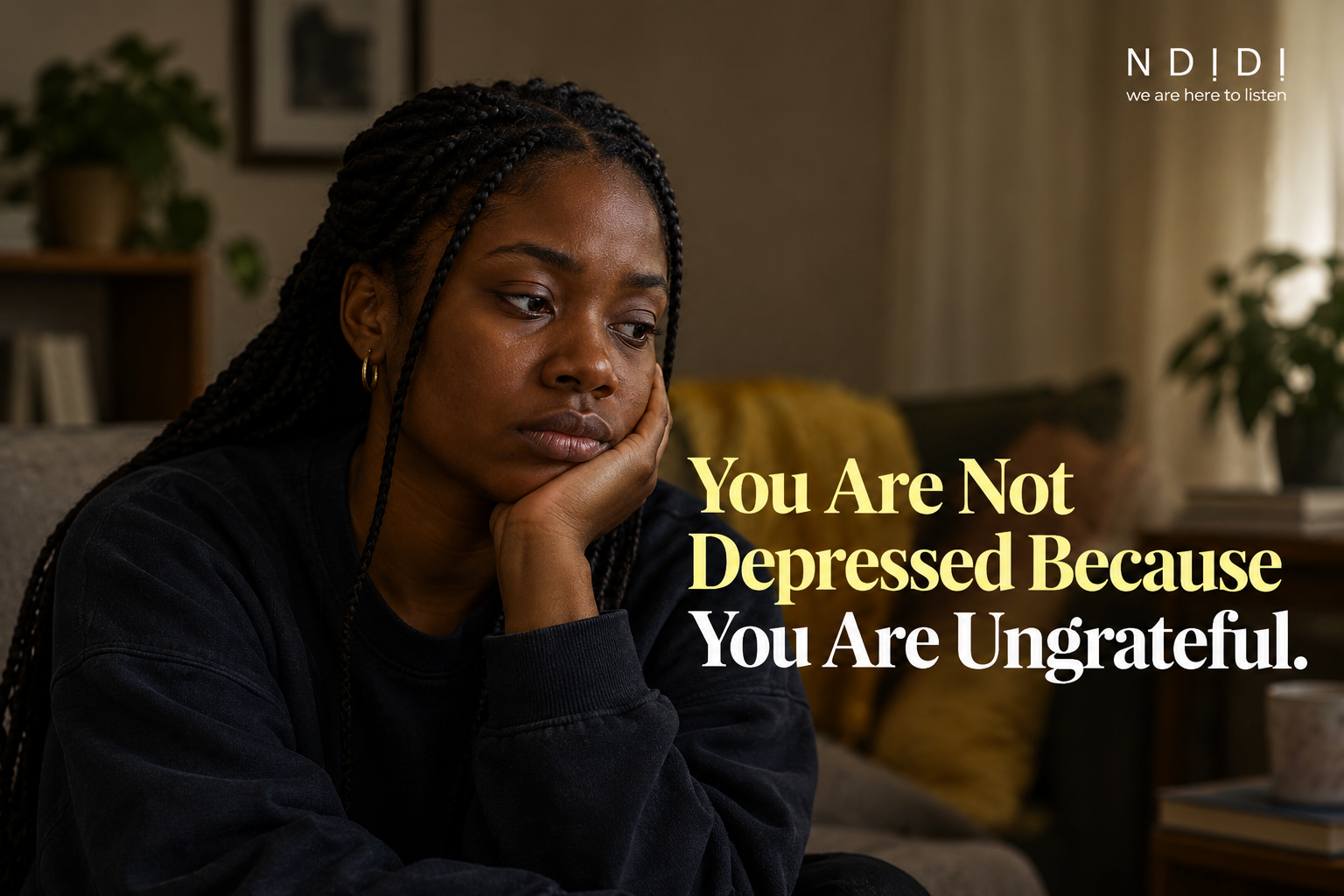
Someone told you that at some point.
Maybe not in those exact words. Maybe it was “count your blessings.” Maybe it was “there are people suffering more than you.” Maybe it was a pastor who said your breakthrough was on the way and you just needed to have more faith. Maybe it was your own mother, looking at everything she sacrificed to give you a better life, quietly implying that sadness in your position was ingratitude dressed up as a problem.
And part of you believed it.
So you made a list of everything you have, everything you should be grateful for and you felt guilty for still feeling heavy after writing it.
This post is for you.
What We Were Taught About Sadness
In Nigeria, sadness has always needed a reason. A good enough reason. A visible, undeniable reason that justifies the weight you are carrying. Lost your job? Okay, you can be sad. Lost a parent? Grief is permitted, but existing in a home, with food, with people who love you, with a functioning body, and still waking up every morning feeling like something inside you is broken?
That requires an explanation.
The explanation our culture reaches for most often is spiritual or moral. Either something is attacking you, or something is wrong with your character. Either you are under a curse, or you are not grateful enough for what God has given you.
Both explanations have the same effect: they put the responsibility for your depression on you, and they send you back to prayer, to gratitude journals, to pushing through instead of toward the support that could actually help.
What Depression Actually Is
Depression is not an emotion. It is not sadness that has overstayed its welcome. It is not ingratitude, weakness, or a lack of faith.
Depression is a clinical condition involving measurable changes in brain chemistry, specifically in the way the brain regulates serotonin, dopamine, and norepinephrine, the neurotransmitters responsible for mood, motivation, and the ability to feel pleasure. The World Health Organisation estimates that over 280 million people worldwide live with depression, making it one of the leading causes of disability globally.
It can look like persistent low mood and hopelessness. It can look like losing interest in things that used to bring you joy. It can look like exhaustion that sleep does not fix, difficulty concentrating, changes in appetite, or a quiet but pervasive feeling that nothing will ever get better.
It can happen to people who have every external reason to be okay.
Research consistently shows that depression does not discriminate by circumstance. It is not caused by having a bad life. It is caused by a complex interaction of genetics, neurobiology, early life experiences, chronic stress, and environmental factors. Gratitude does not correct a chemical imbalance. And the absence of visible suffering does not mean the absence of real pain.
The Gratitude Trap
Gratitude is a beautiful thing. Research actually supports its role in wellbeing studies show that regular gratitude practice can improve mood, strengthen relationships, and build resilience over time but there is a difference between gratitude as a practice and gratitude as a silencing tool.
When gratitude is used to tell someone that their pain does not make sense given their circumstances, it stops being a wellness practice. It becomes a way of invalidating a person’s inner experience by pointing to their outer one.
“You have so much to be thankful for” is not a treatment for depression.
“Other people have it worse” has never once made a depressed person’s brain chemistry normalise.
“Just be positive” does not restore serotonin levels.
These responses, however well-intentioned, do one thing very reliably: they teach people that their pain is not valid, that expressing it is inappropriate, and that the correct response is to push it down and perform wellness instead. In a culture that is already deeply uncomfortable with emotional pain, that lesson lands hard and stays long.
What This Costs Nigerian Families
Depression in Nigeria is profoundly underdiagnosed and undertreated, and the gratitude narrative is a significant reason why.
When the cultural response to low mood is “pray more, be grateful, push through”, people do not seek help until they are in crisis. Families dismiss early symptoms as spiritual attacks or character flaws. Young people hide their struggles to avoid being labelled weak or ungrateful. And the gap between the onset of depression and the point at which someone finally receives support stretches into months, sometimes years.
Studies on mental health help-seeking in Nigeria consistently identify stigma, cultural beliefs, and religious frameworks as the primary barriers to early intervention. The result is not a country of people who do not struggle. It is a country of people who have been given no language for their struggle and no permission to seek help for it.
That has a cost. A real, measurable, sometimes irreversible cost.
You Are Allowed to Not Be Okay
If you have spent months, maybe years, trying to talk yourself out of what you are feeling, trying to be more grateful, more positive, more faithful, and it has not worked, that is not because you have not tried hard enough.
It is because the thing you are carrying is not a gratitude problem. It is a mental health one, and mental health conditions respond to mental health care, not to guilt, not to willpower, and not to comparisons with people who have less. You are allowed to acknowledge that something is wrong even when your life looks fine from the outside. You are allowed to reach for support without first having to justify the severity of your pain. You are allowed to say I am not okay in a culture that has made that sentence feel like a betrayal of everything you have been given.
A Word Before You Go
Gratitude and depression can coexist. You can be genuinely thankful for your life and still be struggling. Both things are true. Both are allowed, but if the weight you have been carrying has started to feel like more than you can manage alone, please hear this clearly: that is not ingratitude. That is a signal. And signals deserve to be taken seriously.
At NDIDI, we work with individuals navigating depression, chronic low mood, and the complicated feelings that come with struggling in silence for too long. If something in this post felt like it was written about you, support is closer than you think.
If cost has been a barrier, we have an affordable therapy package available with our therapist, Oluwagbemisola Osoba, because your mental health is worth prioritising regardless of your budget. Book a session today.