
When You're the Reason Everyone Else Is Okay
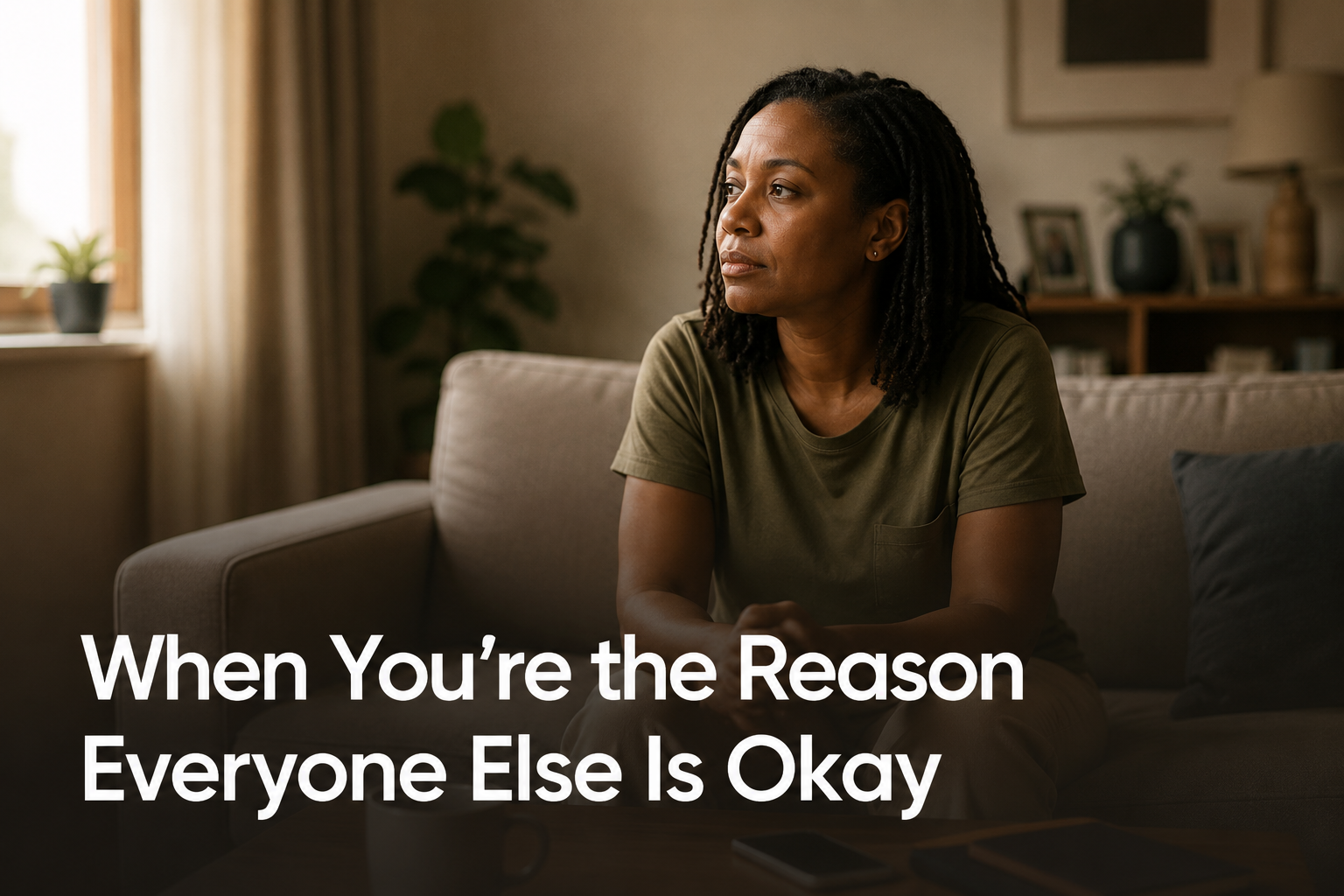
You are the first call.
Not because you asked to be. Not because you applied for the role. But somewhere along the way, without a formal announcement or a conversation, it was decided.
You are the one who holds it together.
And everyone around you has come to depend on that, so quietly, so completely, that most of them do not even realise they are doing it.
How You Got Here
It rarely starts dramatically.
Maybe you were the eldest child, and "look after your siblings" was said so often it became identity before it became a burden. Maybe you were the most emotionally mature person in your family, and maturity, in that environment, was rewarded with responsibility. Maybe you simply noticed that when you stepped in, things got better. When you called first, conflict softened. When you showed up, people felt safer.
So you kept doing it. And the more you did it, the more invisible the role became, to everyone around you, and eventually, to yourself. You stopped noticing that you were carrying something. You just carried it.
What It Actually Looks Like
This is not always the person who is visibly stressed or obviously overwhelmed.
Sometimes it looks like being the most composed person in every room. The one who does not cry at funerals because someone has to manage the logistics. The one who mediates family arguments while privately agreeing with no one and everyone. The one whose phone is always on, always answered, always available.
It looks like knowing everyone's problems in detail and having no one who knows yours.
It looks like being described as "strong" so consistently that strength stops feeling like a quality you have and starts feeling like a cage you live in.
It looks like the group chat where you are the one checking in on everyone — and the silence when the dynamic reverses. Not because people do not care about you. But because you have never signalled that you needed them to.
The Psychology Behind the Role
Psychologically, this pattern has roots.
For many people, becoming the emotional caretaker of a family or a social group begins in childhood. Research on parentification shows that children who are placed in emotionally supportive roles for their parents or siblings early in life often develop a deep association between being needed and being loved. Usefulness becomes the currency of belonging.
As adults, this translates into relationships where care flows almost entirely in one direction. Not because you are incapable of receiving, but because giving feels safer, more familiar, more within your control.
There is also what psychologists describe as thefawn response, a trauma response where a person manages their own anxiety by ensuring the emotional comfort of those around them. If everyone else is okay, there is no crisis. If there is no crisis, you are safe. Keeping everyone okay is not just generosity. For many people in this role, it is survival.
What It Costs You
The cost is rarely immediate. It accumulates.
It shows up as a tiredness that sleep does not fix. A low-grade irritability that you cannot quite trace to a source. A growing sense of invisibility even in rooms full of people who love you.
It shows up in the way you answer "I'm fine" automatically, before you have even checked whether you actually are.
It shows up in resentment, quiet at first, then louder, toward people you genuinely love, because they keep taking what you keep offering without ever thinking to ask what you might need in return.
Research consistently shows that chronic caregiving without reciprocal support is directly linked to burnout, anxiety, depression, and a deteriorating sense of self. This is documented in professional caregivers, but the same psychological mechanics apply to the informal, unacknowledged caregiving that happens within families and friendships every single day.
The difference is that professional caregivers clock out. You do not.
The Loneliness Nobody Talks About
There is a particular kind of loneliness that comes with this role.
It is not the loneliness of having no one around. It is the loneliness of being surrounded by people who need you, love you, and still somehow do not fully see you.
Because the version of you they know is the strong one. The capable one. The one who always has an answer, always has bandwidth, always shows up.
They do not know the version of you that is exhausted.
The version that sometimes wants to be the one who calls crying, not the one who answers.
The version that has questions without answers, wounds without words, and a deep, quiet wish that just once, someone would ask how you are doing and actually wait for a real response.
That loneliness is real. And it is made heavier by the fact that from the outside, your life looks full.
What Needs to Change
This is not a post that ends with a tidy list of tips. Because the truth is, unwinding a role deeply embedded in your identity and your relationships takes time, and it takes honesty. But it starts with a few things worth sitting with.
Letting yourself be seen. Not the version of you that is managing everything, the version that is also struggling. That means allowing at least one person in your life to know that you are not always okay, and practising the discomfort of being cared for rather than just giving care.
Noticing the difference between choosing and defaulting. Not every act of care you give is a conscious choice. Some of it is automatic, habitual, done before you have even asked yourself whether you have the capacity. Awareness of that pattern is where change begins.
Understanding that your needs are not an inconvenience. People in this role often carry a deep, unexamined belief that their needs are too much, too heavy, or likely to burden the people around them. That belief was formed somewhere, and it can be unlearned.
Seeking support outside of the circle. Therapy offers something that the relationships you are currently holding together often cannot, a space where you are not responsible for anyone else's emotional experience. Working with a therapist trained in relational patterns and caregiver burnout can help you begin to understand how this role developed, and what a different way of existing in your relationships could look like.
A Note Before You Go
If you read this and felt seen, if something in these words landed in a place you have not let many people reach, I want to say something directly to you.
The fact that everyone around you is okay is not proof that you are fine. It is proof that you are tired, and remarkably good at hiding it. You deserve the same quality of care you give so freely to everyone else. Not as a reward for finally breaking down. Not when you have nothing left to give. Now. As you are. Simply because you are human, and humans need tending to.
At NDIDI, we work with individuals navigating relational burnout, caregiver fatigue, and the quiet exhaustion that comes from holding everyone else together. If this resonates, and if cost has been a barrier, we have an affordable therapy package available with our therapist Oluwagbemisola Osoba.
You have held everyone else up long enough. Let someone hold you too.