
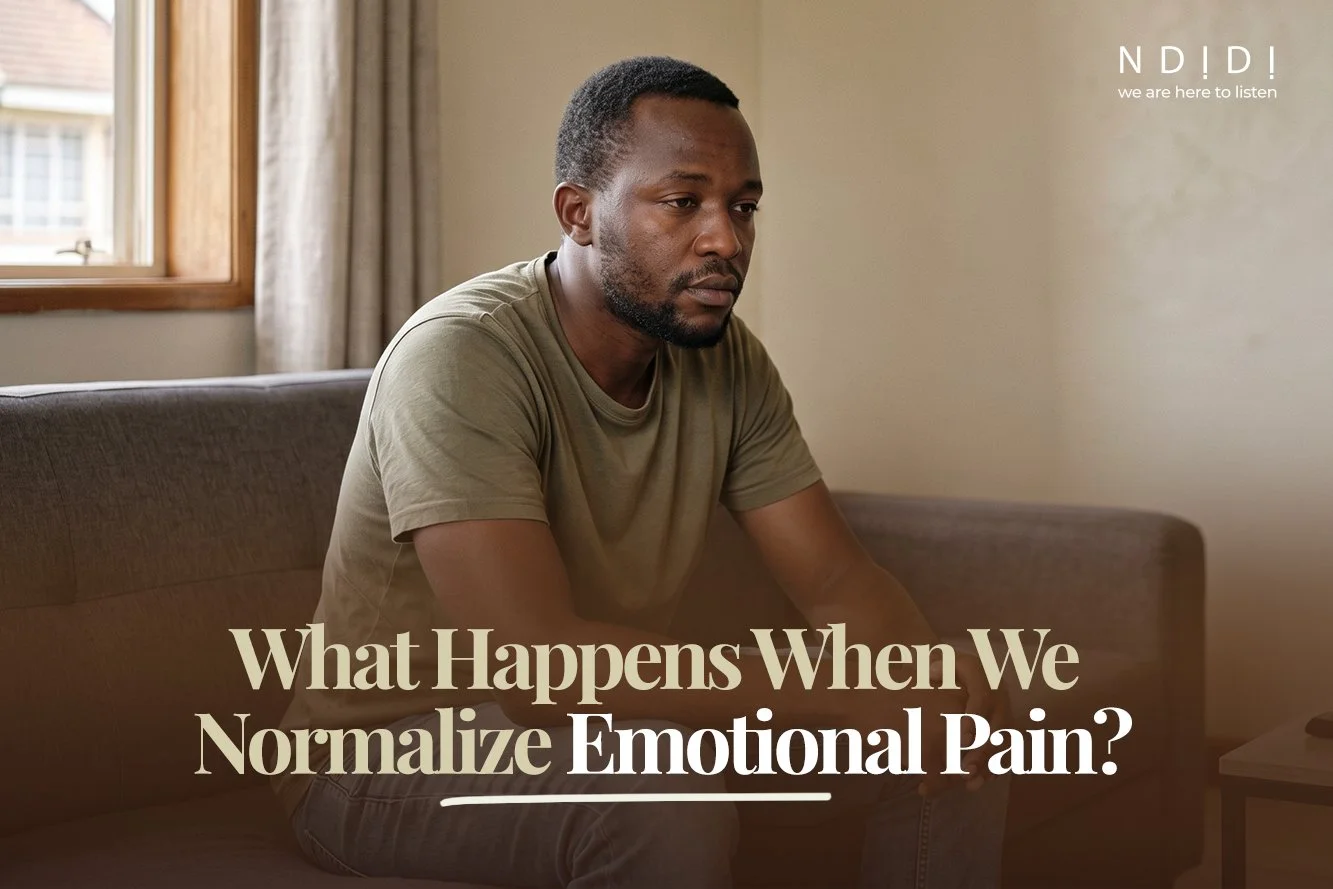
What Happens When We Normalize Emotional Pain?
Think about how many times you have heard someone say,
"It's just life."
"Everybody is going through something."
"At least you're alive."
These words are not always wrong. But sometimes, they quietly teach us to stop taking our own pain seriously.
And that is where the problem begins.
We Were Raised to Endure
In Nigeria, endurance is almost a spiritual value. You are taught from a young age that suffering is temporary, that your grandparents survived worse. And while there is beauty in that kind of resilience, there is also a danger that hides inside it.
The danger is this: when we are surrounded by people who are also in pain but pushing through, we begin to believe that pain is just the baseline. Normal. Expected. Something to outlast, not something to address.
We stop asking, "Am I okay?"We start asking, "Am I coping?"And we learn to call coping, healing.
But they are not the same thing.
"Coping is getting through the day. Healing is no longer dreading it."
What Normalizing Pain Actually Looks Like
It does not always show up loudly. Most of the time, it is quiet. It looks like:
The person who has had a tight chest every Sunday evening for years calls it "work stress."
The woman who cries in the bathroom at work and tells herself she just needs to be stronger.
The man who has not felt joy in months but stays busy so he does not have to notice.
The young adult who cannot sleep, cannot focus, cannot breathe properly but does not say anything because they do not want to worry anyone.
None of these people are dramatic. None of them are weak. But all of them have been taught, in one way or another, that what they are feeling is not serious enough to address.
And according to the World Health Organization, this delay in recognising and responding to emotional pain is one of the leading reasons mental health conditions go untreated globally including here in Nigeria.
Why We Dismiss Our Own Pain
There is a psychological concept called emotional invalidation, when a person's emotional experiences are rejected, ignored, or dismissed, whether by others or by themselves. Over time, this teaches the brain to second-guess its own distress signals.
In simple terms: you stop trusting your own pain.
You ask yourself, "Is this really that bad?" You compare yourself to people who "have it worse." You tell yourself to be grateful. And in doing so, you silence the very signal your body and mind are sending to say, "Something here needs attention."
Research published in Behaviour Research and Therapy found that people who habitually suppress or dismiss their emotions are significantly more likely to experience chronic anxiety and depression over time, not less. Pushing through does not make pain smaller. Often, it makes it louder.
How Does This Show Up in Relationships and Families?
When one person normalizes their pain, it rarely stays with them alone. It travels.
It shows up as a parent who cannot regulate their emotions because they never learned how. A partner who shuts down during hard conversations because vulnerability was never safe. A child who watches the adults around them suppress everything and learns, very early, that feelings are inconvenient.
Studies on intergenerational trauma show that unprocessed emotional pain does not just disappear, it shifts shape and gets passed down. The silence we inherit becomes the silence we teach. This is why healing is not just personal. It is generational.
The Difference Between Acceptance and Resignation
Here is something important to hold:
Acknowledging that pain is common is not the same as accepting that you must live in it forever.
Grief is common. That does not mean you cannot be supported through it.
Anxiety is common. That does not mean you cannot learn to manage it.
Burnout is common. That does not mean you cannot rest and recover.
Normalizing emotional pain at its best says, "You are not alone."At its worst, it says, "So stop talking about it." The goal is to hold the first truth without sliding into the second.

What It Looks Like to Take Your Pain Seriously
It does not have to be dramatic. It starts small.
1. Name what you are feeling
Not just "stressed" or "tired." Sit with it. Are you grieving something? Afraid? Lonely? Overwhelmed? Research shows that naming emotions precisely, a practice called emotional granularity, actually reduces their intensity and helps the brain process them more effectively.
2. Stop asking if it is "bad enough"
You do not need to be in crisis to deserve support. Persistent sadness, low energy, disconnection, numbness, these are all valid reasons to reach out. You do not have to wait until you are breaking to ask for help.
3. Talk to someone who is trained to listen
A therapist is not just for emergencies. Therapy is a space to process, understand, and grow before things escalate. The American Psychological Association notes that early intervention consistently leads to better outcomes than waiting for a crisis point.
4. Challenge the narrative in your community
When someone around you opens up about struggling, resist the urge to say "it could be worse." Instead, try: "That sounds really hard. How are you holding up?" Small shifts in language create space for honest conversations and honest conversations save lives.
5. Rest without guilt
Rest is not a reward for productivity. It is a basic human need. If you are exhausted, emotionally, mentally, physically, that is your body communicating something real. The Sleep Foundation links chronic rest deprivation directly to worsened anxiety, depression, and emotional regulation. Listening to your body is not laziness. It is wisdom.
Conclusion
Pain is Common. Suffering Alone Should Not Be.
There is nothing wrong with acknowledging that life can be hard, that some seasons are heavy, that struggle is part of the human experience.
But there is a version of that acknowledgment that goes too far, the version that says your pain is too ordinary to tend to, too familiar to question, too common to be worth addressing.
You deserve more than endurance.
You deserve curiosity about your own inner life.You deserve support that helps you actually feel better not just cope.You deserve to imagine a version of yourself that is not just surviving.
That version of you is possible.And it starts with taking your pain seriously enough to do something about it. You do not have to keep carrying this alone.
At NDIDI, we create space for real conversations about emotional pain, without judgment, without pressure, and with deep respect for your story. If something in this post resonated with you, we would love to hear from you. Book a session with our team and take the first step toward feeling better, not just coping.