
When Family Is the Trauma: Navigating Mental Health in Difficult Home Environments
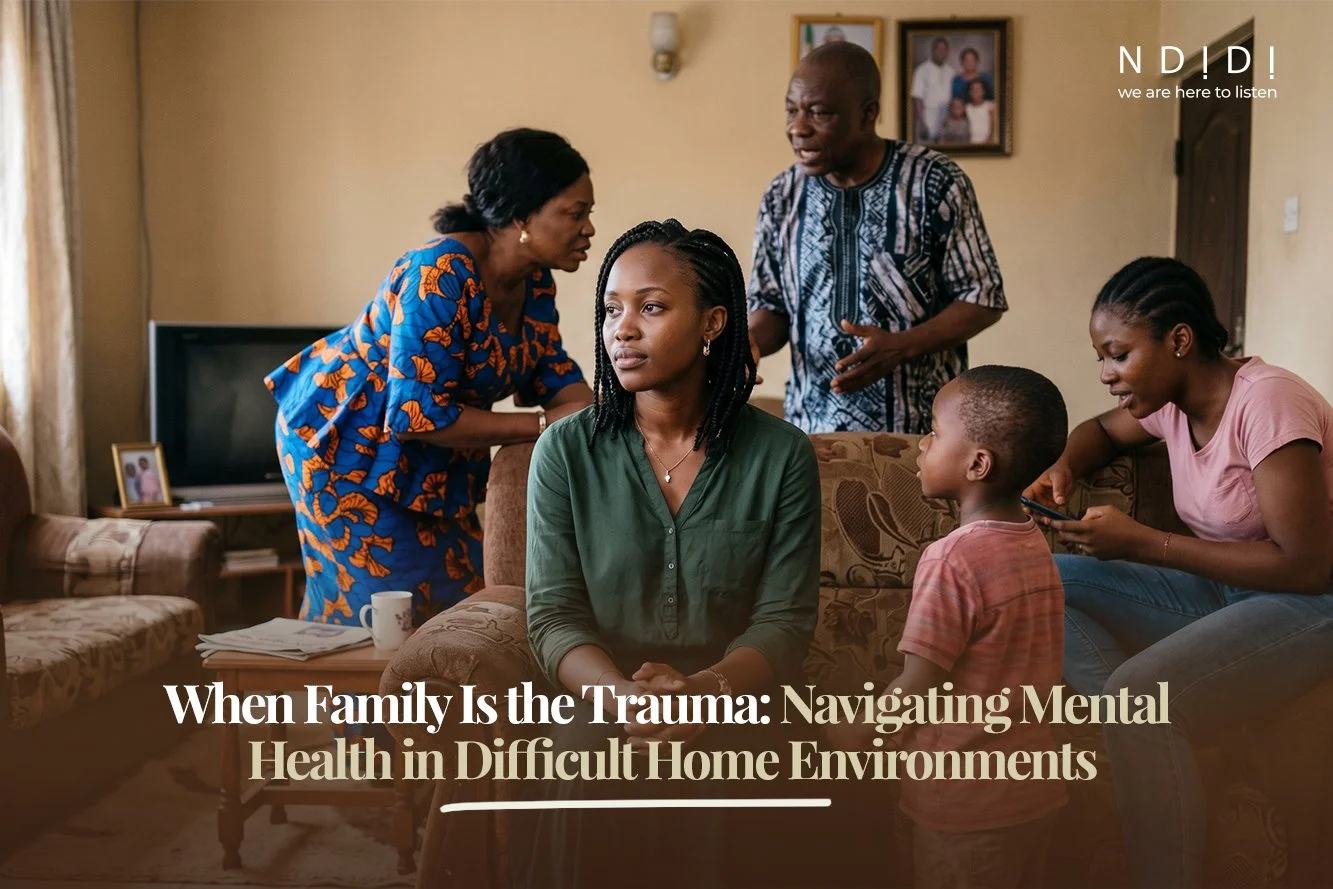
There is a kind of wound that is hard to explain.
Not because it didn't happen. But because of who caused it.
When the source of your pain is your own family, the people who were supposed to be your first safe place, something complicated happens inside you. You love them. You grieve for them. You protect them, even from yourself.
And for a long time, you may not even have the words to say: this hurt me.
When Home Does Not Feel Like Home
We are raised to believe that family equals safety.
In Nigerian culture especially, the home is held up as a fortress. A place of belonging. A place where love is unconditional and protection is guaranteed. For many people, this is true.
But for others, home is where they first learned to:
Make themselves small
Stay quiet to keep the peace
Earn love rather than simply receive it
Survive, rather than simply live
When the environment that was supposed to build you is the same one causing you harm, the impact on your mental health can be deep, lasting, and difficult to name.
What Difficult Home Environments Can Look Like
Trauma within the family doesn't always arrive loudly.
It can be quiet. Layered. So normalised within cultural life that you spend years wondering if what you experienced even counts.
Some of it looks like:
Emotional neglect: Growing up in a home where feelings were dismissed, mocked, or simply never acknowledged. Being told "stop crying" or "you're too sensitive" so often that you eventually stopped knowing how you felt at all. Research has shown that emotional neglect is directly linked to increased anxiety symptoms and poor family functioning over time.
Chronic criticism: Parents or caregivers whose love always felt conditional, whose approval was always just out of reach and whose words left marks on your sense of self that you are still, quietly, trying to heal.
Parentification: Being made responsible for a parent's emotional state, the household finances, or managing family conflict as a child. Carrying adult burdens long before you were ready.Studies show that emotional parentification is consistently linked with anxiety, depression, and psychological distress in adulthood.
Volatility and unpredictability: Homes where moods shifted without warning, conflict was frequent, and you spent your childhood reading the room just to feel safe.
Enmeshment: Families where boundaries barely existed and your autonomy was treated as betrayal. Being your own person felt like a threat to the family's peace.Research confirms that growing up in enmeshed family systems is associated with anxiety, depression, and long-term difficulties forming healthy relationships.
None of these require a single dramatic event to cause real damage. Ongoing, everyday experiences shape how a person sees themselves, relates to others, and moves through the world, long after they have left the home.
The Mental Health Consequences
People who grow up in or currently live in difficult home environments often carry the effects in ways they don't immediately connect to what happened at home.
These can include:
Anxiety, hypervigilance, or a persistent sense that something is about to go wrong
Depression or a chronic, low-level sadness that doesn't seem to have a clear cause
Difficulty trusting others or forming secure, stable relationships
People-pleasing behaviours and an inability to say no without guilt
A deep, quiet belief that you are either too much, or never enough
The connection between early home environments and mental health is well-established. What is less often discussed is how hard it can be to make that connection yourself, especially when you love the people involved, when you have been told to keep family matters private, or when you have simply never been given the language to describe what happened.
The Cultural Weight
In many Nigerian homes, there is an unspoken rule:
“You do not speak ill of your family.You do not air what happened behind closed doors.You endure, you forgive, and you move forward.”
Respect for elders is a value worth holding. Family loyalty matters. But loyalty should never become a requirement to deny your own lived experience.
Acknowledging that your home environment caused you harm is not the same as dishonoring your family. It is, in fact, one of the most honest and courageous things you can do. Because healing cannot begin where truth is not allowed.
What Navigating This Can Look Like
If you are currently in a difficult home environment or trying to make sense of one you grew up in, a few things are worth knowing.
Your experience is valid. The absence of a single dramatic event does not invalidate years of harm.Cumulative, low-grade trauma is real and its effects are well-documented across the lifespan.
You are not the problem. The coping mechanisms you developed made sense in the environment you were in. They helped you survive. It's okay if they no longer serve you now.
Healing does not always require confrontation. Some people find resolution through difficult conversations with family. Others find it through therapy, community, and the slow work of rebuilding their sense of self. Both paths are real.
Distance, physical or emotional, can be an act of self-care. Choosing to limit contact with people who consistently harm you is not abandonment. It is protection.
You do not have to carry this alone. These are not wounds that willpower alone can close. Support exists, and reaching out for it is not a weakness. It is one of the bravest things you can do.
Conclusion
If any of this resonates with you, whether you are currently navigating a painful home environment or finally beginning to understand experiences from your past, please know:
What you experienced was real.
Your feelings about it make sense.
You deserve support, not silence.
At NDIDI, we work with individuals navigating complex family dynamics, relational trauma, and the long-term effects of difficult home environments. We offer a safe, confidential, and culturally grounded space for you to begin your healing journey.
And if cost has been a barrier, we hear you. We now have an affordable therapy package available with our therapist, Oluwagbemisola Osoba, because access to support should not be a luxury.
You don't have to keep carrying this alone.Book a session with us today.